Areta scaled Areta Market to six branded marketplaces on one codebase, with WAYF.
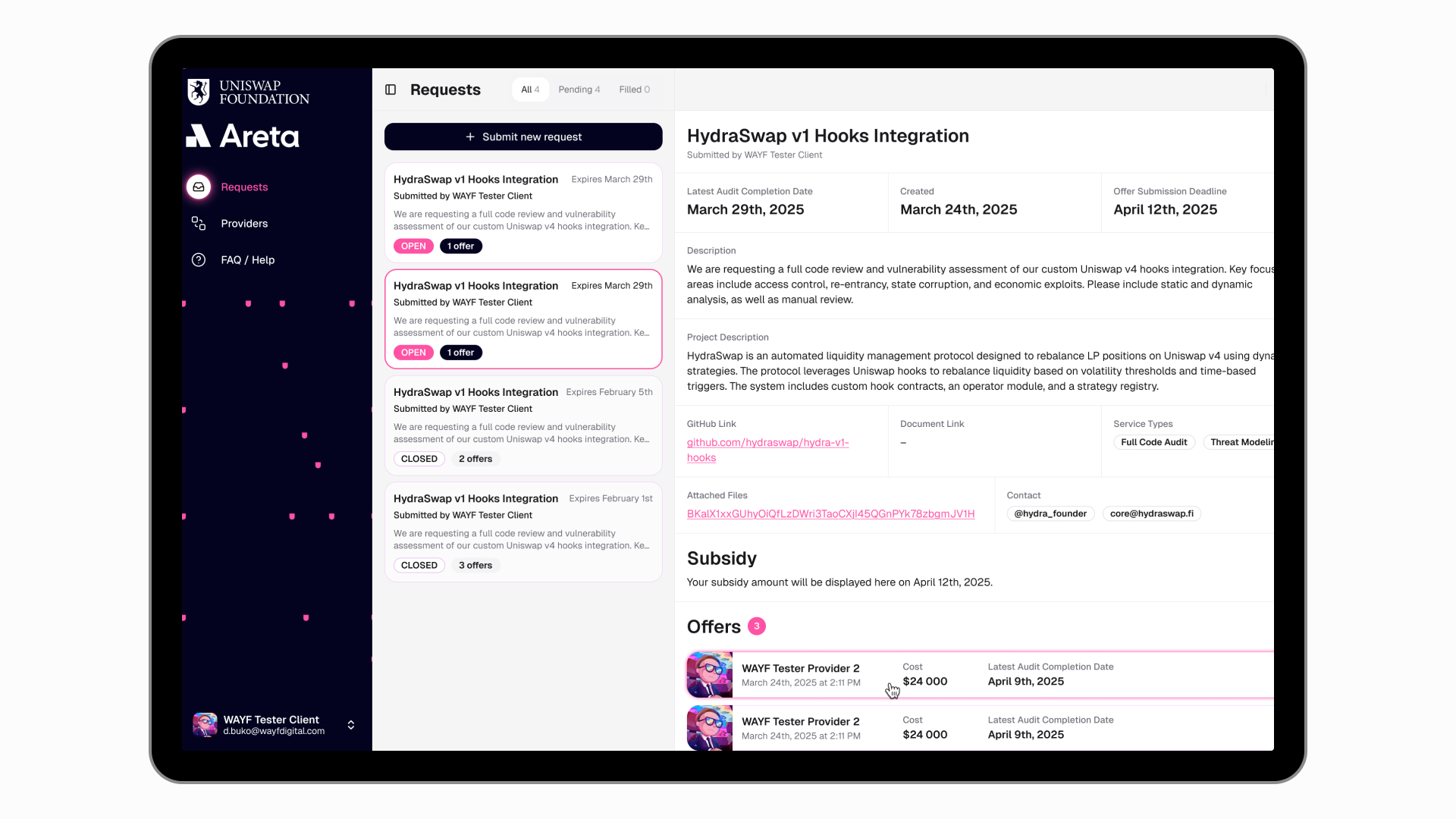
Areta builds financial and security infrastructure for the web3 economy. Its Areta Market platform connects builders with elite security auditors and runs branded audit marketplaces for major ecosystems, Uniswap among them. When one marketplace had to become many, each with its own partner brand, its own users, and its own data, we designed and built the platform that runs all of them as one system. Areta Market now powers six active ecosystems from a single codebase, run by one team, with updates that reach every platform in minutes.

- 6
- Active branded marketplaces in production
- 1
- Shared codebase behind every ecosystem
- 0
- New engineers added scaling from 1 to 6
- Minutes
- To ship a fix across all six platforms
- 3
- Co-founders, from Blackstone and McKinsey
One marketplace worked, and six partners each wanted their own. The team that built the first could not hand-build five more.
Areta Market began as a single marketplace connecting web3 builders with elite security auditors, where a bad audit is not just costly but existential. It worked, and the demand that followed was for more of them: major ecosystems that wanted an audit marketplace under their own brand, with their own users, their own providers, and their own data kept separate from everyone else's. Turning that demand into a business meant the platform had to multiply without the team multiplying with it.
-
Six partner brands running on one product.
Each ecosystem had to read as the partner's own marketplace, carrying that partner's brand end to end. Branding, configuration, and provider roster differ per partner, while the underlying product stays one thing to build and maintain.
-
Isolated users and data, per ecosystem.
A marketplace for one ecosystem cannot leak users, listings, or procurement data into another. Each one needed a separate user base and a separate database, with isolation that holds under real traffic.
-
One team that keeps up as the count grows.
Standing up a new marketplace could not mean standing up a new engineering team. The same team had to operate every ecosystem, so onboarding a partner stays an operational step the existing team absorbs.
-
Changes that propagate to every ecosystem.
A fix or a new feature had to reach all active marketplaces without editing six separate codebases by hand. One source of truth, deployed everywhere, so the platforms never drift apart.
Build it once as a multi-tenant platform. Every new ecosystem becomes a matter of configuration.
We treated Areta Market as a multi-tenant platform from the first line. One application serves every ecosystem; what changes between them is data and configuration, while the code stays shared. A new partner marketplace is provisioned, branded, and populated with its own providers through the same system that runs the ones already live.
That decision is what keeps the team small. Onboarding an ecosystem is an operational task on a running platform, so the sixth marketplace drew on the same team and the same codebase as the first. Nothing about adding a partner asks for a parallel build or a separate deployment to babysit.
The test we held the architecture to: adding the sixth ecosystem should cost the team about what the second did. It did, and that is the whole point of building it once.
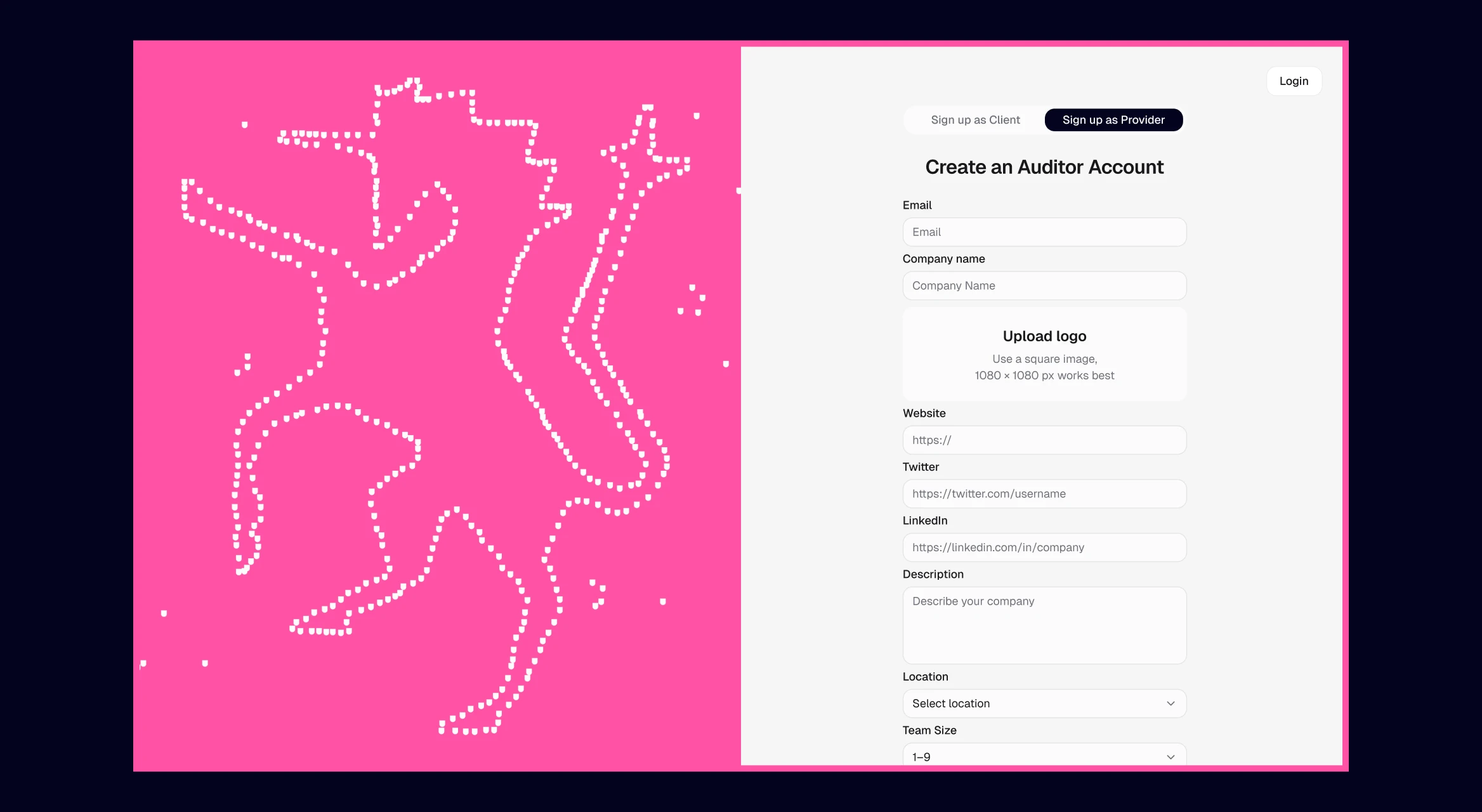
One shared codebase serves all six marketplaces, each with its own users and its own database behind it.
The platform is a single application with per-ecosystem tenancy. Every marketplace runs against its own database and its own user base, so a partner's users, providers, and procurement records stay isolated from every other ecosystem's. The shared codebase means a change is written once and reaches all of them; the separate data stores mean nothing crosses between partners.
Deployment is centralised. When we ship a fix or a feature, it propagates across all six active ecosystems in minutes from one pipeline. There is a single source of truth to reason about, which is what keeps six live marketplaces from drifting into six subtly different products.
- Multi-tenant platform
- Isolated database per ecosystem
- Separate user base per ecosystem
- Single shared codebase
- Centralised deploys
- 6 active ecosystems
A marketplace for audits, where trust is the product. Transparent procurement that reads as the partner's own.
The marketplace side of Areta Market is audit procurement made transparent. A web3 team browses vetted security providers, sees what each one covers, and engages the right one, in a category where a missed vulnerability is existential. We designed that flow to be legible and quick, so choosing an auditor is a decision the team can reason about in the open.
Every ecosystem wears its partner's brand on top of that shared experience. A marketplace running under a major ecosystem's name reads as native to it, while the procurement flow, the provider model, and the way data is kept separate stay consistent underneath. The partner gets their own marketplace; Areta keeps one platform to run.
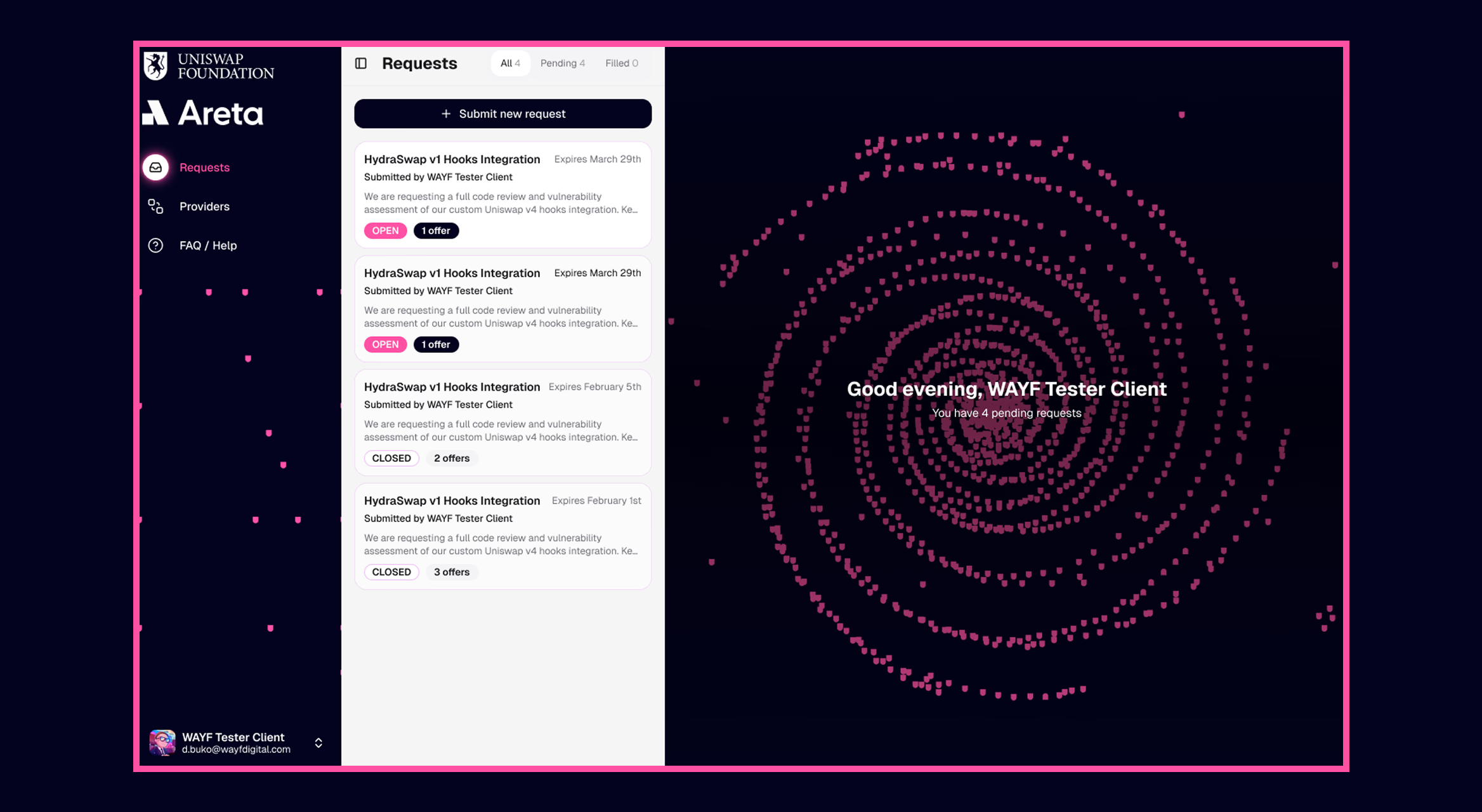
A founding team out of institutional finance and strategy, building the investment bank of the web3 economy.
Areta is a crypto-native investment bank offering M&A, capital formation, and strategic governance for the web3 economy, trusted by the Uniswap Foundation, CoinGecko, Aave, and Base. Two of its co-founders were private-equity investors at Blackstone, and a third came out of McKinsey and early-stage venture capital. That background sets the standard the platform had to meet, and it is the reason Areta Market treats a security audit as infrastructure the ecosystem depends on.



Six branded marketplaces in production, from one codebase and one team, with updates that reach all of them in minutes.
Areta Market went from one marketplace to six active ecosystems without adding a developer. Each partner runs a marketplace under its own brand, with its own users and its own database, while Areta maintains a single platform and ships changes across all of them from one place. Onboarding the next ecosystem is an operational step on a running platform, which is what lets a small team keep saying yes to partners.
One codebase, six ecosystems, zero new engineers to scale from the first to the sixth. The architecture is the outcome: adding a partner costs the team about what the last one did.
We're booking content platform
engagements for 2026.
Twenty-five minutes to walk through the work and decide if we're the right team for it. Scoping and a fixed price come after.